

Enterprise Capacity Plan
Forecast when you run out of space at three levels: group, device, and pool.
Enterprise Capacity Plan forecasts when storage runs out, and it does it at three levels: group, device, and pool. Most teams check only one of these, usually device, and each level catches a failure mode the others miss. Visual One plans at all three; most tools stop at the device.
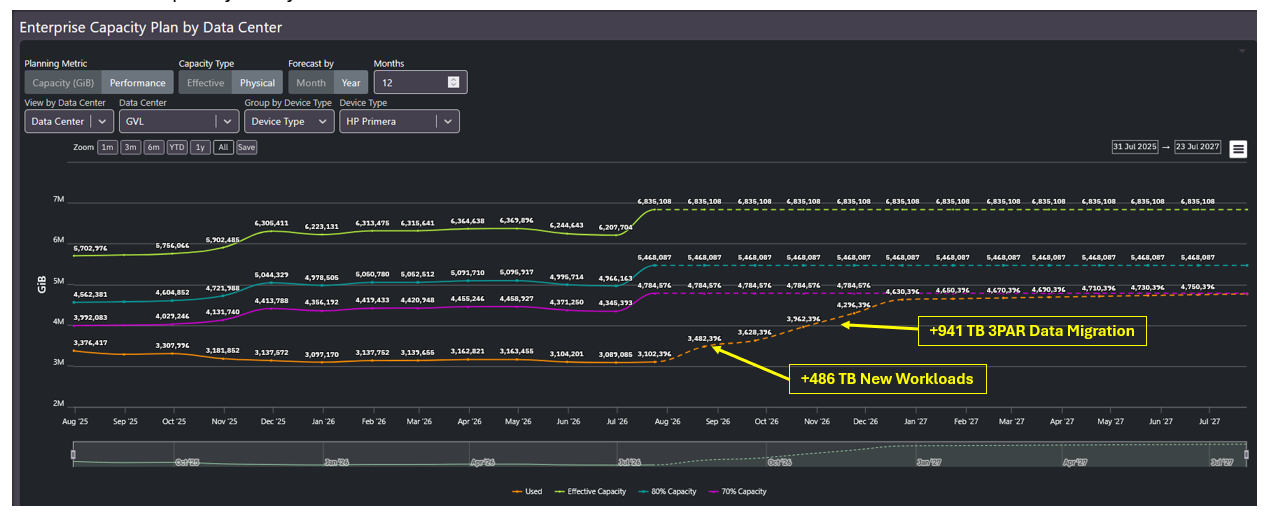
What this screen shows
Used capacity plotted against effective capacity and warning thresholds, with a forecast horizon in months or years. The plan runs at whatever scope you select: a whole data center, a device group you define, a single device, or a single pool. Planning can use capacity or performance as the metric, and the two dimensions together determine what an upgrade actually needs to deliver.
Why three levels
| Level | What it catches | The failure mode it prevents |
|---|---|---|
| Group | Imbalance across arrays sharing a role | Buying capacity when rebalancing would do |
| Device | The standard per-array runway | The annual spreadsheet exercise, done continuously instead |
| Pool | Hidden capacity need inside healthy-looking devices | A full pool causing an outage on a device with free space |
Group plans treat arrays that share a role as one unit. That reframes upgrades as balancing questions. In one case, a device-level plan showed a $500,000 upgrade needed on one of two arrays doing the same job in the same data center; the group-level plan showed zero needed, because the pair had enough combined capacity. Rebalancing the workload between them, a storage vMotion in that VMware environment, replaced the purchase entirely.
Device plans are where most manual capacity planning happens today. Running them continuously replaces the annual spreadsheet exercise.
Pool plans catch the hidden capacity need. A device with one giant pool and one small pool can look healthy at the device level while the small pool is weeks from full. Allocations cannot span pools, so a full pool is a real outage risk even on a device with free space. The weekly analysis runs pool plans automatically and flags pools approaching their limit.
Tip: If a device has multiple pools, never rely on the device-level plan alone. The pool plan is where the surprises are.
Related screens
Trends shows the historical growth the forecast extends. Enterprise Summary shows the pool counts that determine how much pool-level planning matters for each device.